

CWU Confefrence 2026: Young Workers Motion 22 Calls For The NEC To Campaign For Government Action On Endometriosis
In an emotional debate, with speakers also giving their personal experiences, Motion 22 submitted by CWU's Young Workers Conferencehighlights the trauma being experienced by sufferers; given it can take the NHS GPs and Specialists, up to 10 years to diagnose the disease in patients.
Proposing Motion 22 was Jack Leslie, Scotland No5 Branch, telling Conference that:
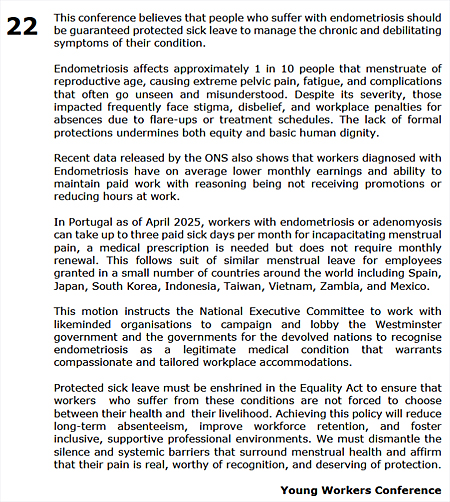 "Before I first read this motion, I had a vague understanding of endometriosis. I believe many will be in a similar position. So for your benefit, the condition is defined by the National Health Service as follows.
Endometriosis is where cells similar to those inside the womb grow in other parts of the body, affecting one in ten women in the United Kingdom. It sounds common but innocuous, doesn't it?
The reality is not. Stage 4 endometriosis at its most severe causes large ovarian cysts and adhesions that bind organs together. The only permanent treatment being complete hysterectomy. This changes people's lives.
I'm sure a few are now beginning to question why a man is so impassioned about a women's issue. I put this question to you.
Why am I, as a young man stood here, still trying to secure accommodations for women for conditions over which they have no control?
Why have these basic rights not been enshrined in law since women began working outside the home? Beyond this, why is medical misogyny still something we are talking about today? Endometriosis, despite its common occurrence, carries a 2% diagnosis rate.
In the one place that your life depends on being taken seriously, women are brushed aside. The hands are washed while the pain endures. Until the day that these tales are history, true equity is but a pipe dream. Individuals living with this condition are so often condemned for what they cannot change. Some work through chronic debilitating pain, while others are in agony such that they cannot leave bed, never mind cross the door.
Here before you stands the beginning of a tidal change. Never again will someone suffering with this condition have to work in agony for fear of retribution. You today can, by raising your hand in support, create not just a more equal workplace, but seal a more equal nation. Do you wish a better future upon the daughters of tomorrow, never allowing them to suffer as our sisters do today? You now have the tangible opportunity to transform lives.
We cannot cure the ailment, but we can lessen the fear. Conference, I do not ask. I implore and beseech you, join with me and create a story that you will be proud to tell. Thank you."
Seconding the motion, Peter Sharrocks, North East Branch told conference:
"I rise to second this motion, not only as an ally, but as someone with a wife and daughter who lives with endometriosis.
I have seen up close the pain, the exhaustion and the impact this condition has on everyday life. And I have also seen how often that pain is hidden, dismissed or misunderstood. That personal experience is why I feel so strongly about this motion. Endometriosis affects around one in ten people who menstruate and are of reproductive age. That is a significant part of our workforce, yet despite how common it is, it remains one of the most overlooked and underestimated medical conditions.
Those who live with it endure extreme pelvic pain, chronic fatigue and symptoms that can be completely debilitating. But because these symptoms are invisible, they are too often questioned or minimised.
Conference, when someone you care about is struggling to get out of bed, struggling to stand upright, or struggling to work through a flare-up, you realise very quickly that this is not just a bad period, it is a chronic, life-altering condition. And the idea that people are penalised at work for managing it is simply unacceptable. But we know change is possible.
Other countries have already shown us this can be done. This motion calls on our National Executive Committee to work with like-minded organisations and lobby Governments across the UK to recognise endometriosis as a legitimate medical condition requiring compassionate, tailored workplace accommodations and, crucially, to enshrine protected sick leave within the Equality Act, so that no worker is ever forced to choose between their health and their livelihood.
Conference, speaking as a man and as someone who has watched a loved one fight through this condition, I want to say this clearly. We have a responsibility to stand alongside those affected, to challenge the silence, the stigma and the systematic barriers that have surrounded menstrual health for generations, and to use our voices to help drive the change they deserve.
This is about fairness, it is about dignity, it is about creating workplaces where people are supported, not punished, for managing a chronic condition. And it is about affirming something simple but vital: their pain is real, their experiences matter and they deserve meaningful protection. I urge Conference to support this motion and stand with those who have been unheard for far too long. Thank you."
Cadence Carnegie, Edinburgh, Dundee and Borders spoke in support of Motion 22, sayng:
"We've heard three weeks allowing them to have the week of their period off. Three weeks allowing them to have the week of their period off to help manage their symptoms. We see in this example that it is possible what we are asking for in this motion. So Conference, tell me, is there a reason why we should not get adjustments for all our members where it is needed?
Conference, please support this vital motion."
Dai Horton South East Wales Amal Branch, was the next delegate to speak to motion 22:
"I support this motion wholeheartedly. It should have been brought years ago. I commend the young workers for bringing it forward. But I've got to pick up on something on the wording of it. We've been talking all morning about respect to people and treating our fellow members with respect. People that menstruate. Now you might notice I'm probably not one of them.
So I asked my female friends what they feel about that. Every woman I spoke to was offended by that term. We need to speak to everyone with respect. And my criticism, to be honest, was mainly directed at the Standing Orders Committee, because I don't understand how they let language that large sections of the population find offensive in. You either respect everyone,
Respect has got to go to everyone. With regard to the Young Workers Conference, well, believe it or not, I was young once myself, so I still am making many wrong steps. I might be making one now. I would suggest, if you're going to do anything like this, speak to women in your family and your friends. Speak to other people. How do they feel?
And that's what I think we should do, is just treat everyone with respect."
Gillian McClatchy, Glasgow District Amal, a first-time speaker,spoke in support support of motion 22, In doing so, she provided conference with harrowing details of the suffering of one of her Branch memebers:
"
I've got a member in my delivery office with endometriosis. I confess I knew very little of this illness before her diagnosis, and found little help trying to educate myself or our manager in ways to help her in the workplace.
My member suffered pains for over a decade before finally going private to get her diagnosis. How many flare-ups has she suffered in those years before? Her diagnosis led to her being able to start medication, but this was just a short-term fix. She was talked into going private for surgery, a laparoscopy, where they removed a lot of the cysts and gave her some relief for a few months.
This procedure cost several thousand pounds and she had to crowdfund to afford that.
So she had to swallow her pride, share her condition with all of us and ask for help just to get relief from these symptoms and knowing that the pain is not easy. Our members and wider community rallied around her to make this possible. So imagine her disappointment that a few months later she's back to square one. In that time she had no time off with the pain managing the lengthy absence due to the surgery and recovery time.
And now, after her flare-ups, she's going to have to take more sick days. Not only is she in pain, but she's worrying about losing over £100 a day in wages just for an absence. These flare-ups are unpredictable for women affected. They can't be planned for and can't be managed into her working week or her personal life.
My Member is now in an AR Tenders Review 2 and future days off may lead to a consideration of dismissal. We must follow the example of these progressive countries in establishing better policy to allow women with endometriosis to continue to work and to continue to contribute in the workplace. Half a dozen single days off in the year shouldn't deem someone unfit to work. My Member now gets monthly injections to manage this condition and keep her in work.
These injections have brought on early menopause. She's having to potentially give up the chance to have a family to be able to keep her job. This motion would give women the peace of mind to choose a treatment without it having to be based purely on the financial impact. Let's keep women at work. Women are still being disadvantaged. Please support this motion."
"So I'm speaking in support of this motion. I'm from the United Tech and Allied Workers branch, so I'm a delegate from Utah. We just really wanted to come up and say in response to the speaker before, we support this motion fully in the wording that it has. As a union, we stand with our trans siblings. And I don't want this to get into a debate about trans people or anything like that. There is nothing in this wording that is discriminatory to anybody.
And I really, really wanted to make that clear. I think we're sick and tired of the trans debate. We know our position as a union already, standing in solidarity with our trans siblings. So I'm in support of this motion. Please vote for."
Chair, Conference, Jean Shurricks on behalf of the NEC speaking in support of this motion. I'd like to thank the young workers for bringing this motion to conference. I'd also like to make a personal thank you to my husband for getting up and speaking and seconding the motion. It meant a lot.
Our eyes are speaking strong support of this motion because the reality faced by people living with endometriosis is not only a medical issue, it's a workplace equality issue, a dignity issue and an issue that has been ignored for far too long.
Endometriosis affects one in ten people who menstruate and are of reproductive age. This is a significant proportion of our workforce. Yet despite its prevalence, it remains one of the most misunderstood and underestimated conditions. Those who live with it endure extreme pelvic pain, chronic fatigue and a range of complications that are often invisible to others. I could go on and on about what the symptoms are and what can happen.
And because these symptoms are unseen, they are often dismissed, doubted and minimalised. Workers with endometriosis frequently face penalties for absences during flare-ups or treatment. They are made to feel unreliable when in truth they are battling a condition that would stop many of us in our tracks. The lack of formal protection forces people to an impossible choice, their health or their livelihoods.
Recent data of the national statistics show the impact clearly. Workers diagnosed with endometriosis have lower average monthly earnings and reduced ability to maintain paid work. Many report being passed over for promotion and pushed into reducing their hours, not because of lack of ability but because workplaces are not designed with the reality in mind.
But Conference, we do not have to accept this. Other countries have already recognised the need for compassion-tailored support. In Portugal, since April 2025, workers with endometriosis or adenomyosis can take up to three paid days sick per month for incapacitating menstrual pain. If it's possible elsewhere, it's possible here.
Conference, this is not just about fairness, it is about retention, wellbeing and creating a workplace where people can thrive rather than hide their pain.
It is about dismantling the silence and stigma that have surrounded menstrual health for generations. And it is about affirming something simple but vital, that the pain experienced by those endometriosis sufferers is real, it's serious and it deserves meaningful protection. I urge Conference to support this motion and stand with those who have been unheard for far too long. Thank you.
Despite there having been no opposition to the Motion, following questions raised about the terminology of the motion, the Chair gave the moving Branch; the opportunity to clarify the terms of the motion:
"So directly concerning the wording of the motion, you will notice both the wording on the pad and what was contained within my speech is slightly different. What I would like to see is our union to take a clear policy on how these matters are to be addressed. I think we need clarification, all of us do, to ensure that we continue to be respectful to everyone, both our trans colleagues and our female colleagues.
We must ensure that we don't offend anyone inadvertently by simply phrasing something wrong. So I would like to see a clear policy going forward that we take a position on how we express these issues and I'm welcome to any education that I could take and any others could take on to ensure that we treat everyone fairly.
The Motion was carried unanimously.
Source: CWU
